What a Full Home Renovation Really Costs

Ask three contractors what a full renovation costs per square metre and you'll get three different answers, each delivered with total confidence. That's not because anyone is guessing. It's because the headline €/m² figure hides more than it reveals. Two of the most commonly quoted ranges for Belgium look like they describe two different markets: one goes from €800 to €2,400 per m², the other from €1,200 to over €3,000 per m². Neither is wrong. Both are incomplete on their own.
What actually decides whether your budget survives the project isn't the number on the quote's first page. It's how that number splits across three layers of work: the structural shell, the technical systems buried inside the walls, and the finishes you'll actually see and touch. Get that split wrong in your head, and a quote that looks generous on paper turns into a site that stalls halfway through, waiting for money that was never allocated to the right place.
Why the €/m² number on its own tells you almost nothing
Start with the two figures that confuse most people at the start of a project. Renovation cost research published by Quebri in 2026 puts a full house renovation in Belgium at €800 to €2,400 per m², depending on scope, finishing level and whether the work is done in one go or staged over time. A separate 2026 breakdown from CULA quotes a turnkey renovation at €1,200 to over €3,000 per m² excluding VAT, with a typical band of €1,500 to €2,500 per m².
The gap isn't a contradiction, it's two different starting lines. The lower end of Quebri's range likely reflects phased, partial-scope projects where an owner handles some trades separately rather than buying a single turnkey package. CULA's figures are explicitly turnkey and explicitly exclude VAT, which already shifts the baseline upward before a single wall comes down.
The practical fix is one question, asked before you compare any two quotes: does this figure include VAT, architect fees and site overheads, or is it materials and labour only? Two quotes that look €500 per m² apart often turn out to be measuring different things.
A second apparent conflict resolves the same way. Quebri describes the structural shell, or ruwbouw, as typically accounting for the majority of a renovation budget. CULA's breakdown lists structural work and insulation at 20 to 30%, with technical installations as a separate line at 25 to 30%. Those aren't competing claims. CULA simply draws its boundary differently, splitting what Quebri lumps together as "structural shell plus technical systems" into two separate categories. Once you treat structural work and technical installations as the two halves of what sits underneath the finishes, the two sources line up: together they absorb roughly half to three-fifths (45 to 60%) of a typical budget. The visible layer, finishes, is the smaller share, not the bigger one most people assume it to be.
Where the money actually goes: the three-layer split
Once the headline figure is set aside, every renovation budget breaks down the same way, regardless of the property. Three layers, stacked in a fixed order:
- Ruwbouw — the structural and watertight shell: load-bearing walls, roof, foundations, insulation, window and door openings.
- Technieken — heating, ventilation, electrical wiring, plumbing and drainage, everything that ends up inside a wall cavity or under a floor.
- Afwerking — the finishes: plastering, flooring, painting, kitchen and bathroom fit-out, joinery.
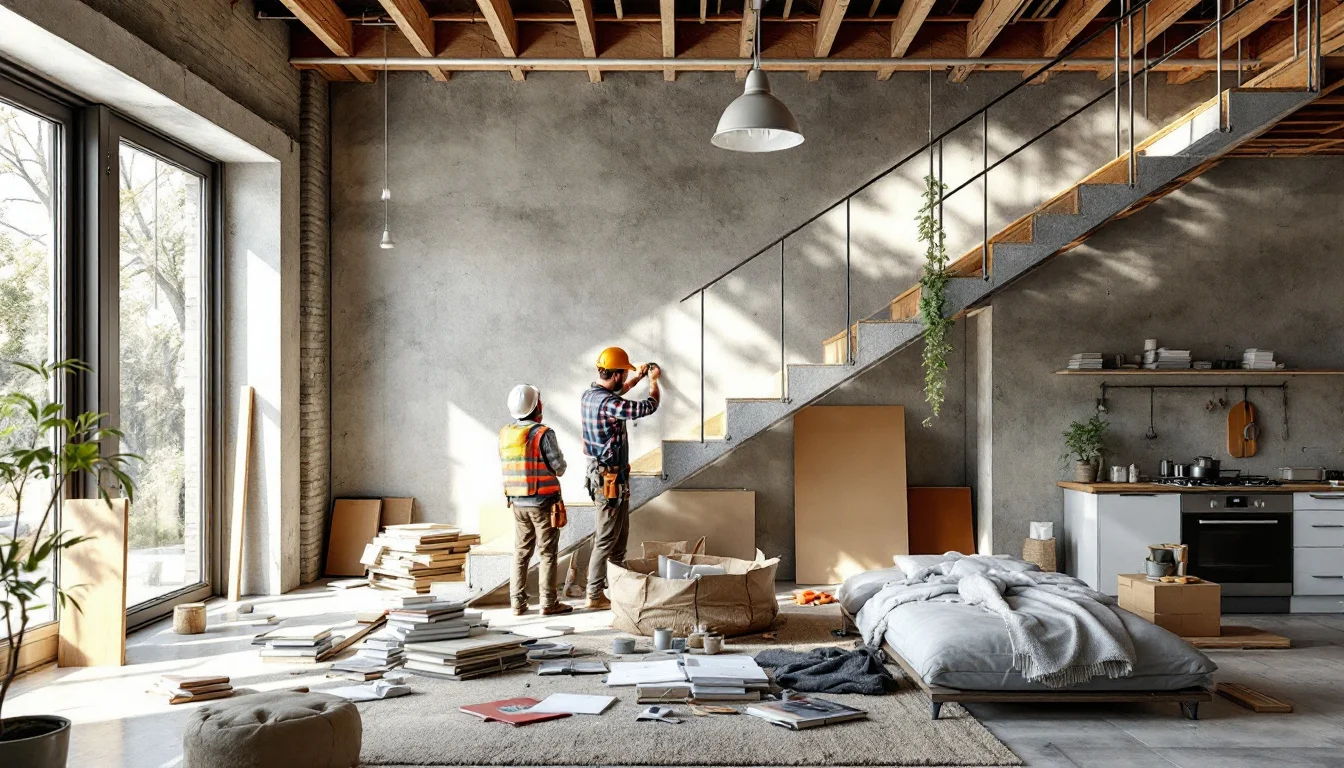
The order isn't optional. Structural and technical work must happen before finishing work starts, every time. If you tile a bathroom floor before the plumber has confirmed the drain routing, or paint a wall before the electrician has chased in the cabling, you pay to rip out finished surfaces so someone can reach what's underneath. That's not a hypothetical risk on older houses. Budgets blow past their contingency not through bad luck, but through sequencing that puts the visible work ahead of the hidden work.
What three real budgets look like broken down
Applying that percentage split to real property sizes turns an abstract framework into euro figures you can sanity-check against your own quote. The table below takes the midpoint of CULA's 2026 turnkey budget bands for three common Belgian property types and spreads it across the shell, technical and finishing layers using the midpoints of CULA's percentage ranges, with demolition and removal costs folded into the shell figure. These are illustrative figures derived from published ranges, not measured costs for any specific project — your own quote will land somewhere inside the band, not exactly on the midpoint.
| Property | Typical budget (excl. VAT) | Shell (structure + insulation + demolition) | Technical systems | Finishes (exterior joinery + fit-out) |
|---|---|---|---|---|
| 90 m² Brussels apartment | €110,000–€160,000 | ≈€42,500 | ≈€37,000 | ≈€47,000 |
| 150 m² terraced house | €220,000–€320,000 | ≈€85,000 | ≈€74,000 | ≈€94,500 |
| 200 m² detached villa | €350,000–€500,000 | ≈€134,000 | ≈€117,000 | ≈€149,000 |
Two things stand out. First, the shell and technical layers together consistently outweigh finishes, confirming the reconciled reading of both sources above. Second, the per-m² cost doesn't fall neatly as the property gets bigger. A 90 m² apartment renovated at the midpoint of its range works out to roughly €1,500 per m², close to the terraced house's €1,800 per m² and not far off the villa's €2,125 per m². Size alone doesn't buy you a discount.
What pushes a project from the low end to the high end
Four factors decide where a project lands inside these ranges, according to Quebri's 2026 cost research: the condition of the existing structure, the target energy performance, the finishing level chosen, and whether the work is done all at once or staged in phases.
Structural condition is the biggest single driver
A healthy but outdated house costs roughly 30% less to renovate than a building suffering from rising damp or foundation problems, according to CULA's 2026 figures. That one variable is among the biggest single contributors to the spread between a €1,100 per m² project and a €1,800-plus per m² project. A 1970s semi-detached house in reasonable structural shape, kept to a sober finish with a heat pump and standard insulation, might land around €1,100 to €1,400 per m². A pre-war terraced house with a sagging roof, single-glazed windows and old wiring will push well past €1,800 per m² before anyone has chosen a floor tile.Energy performance adds cost upfront, saves it later
Switching to an all-electric setup — a heat pump and thermodynamic boiler — typically adds €15,000 to €25,000 upfront compared with a classic heating system, per CULA's 2026 breakdown. Paired with solid insulation, that choice costs more at the start but locks in lower running costs and less exposure to future swings in fossil fuel prices. It's a capital-cost-versus-running-cost trade-off, not a pure expense.Finishing level is where budgets swing hardest at small scale
A kitchen renovation ranges from €5,000 for a modest refresh to over €30,000 for a fully bespoke fit-out. A bathroom swings from €500 for minor updates to over €25,000 for a full strip-and-rebuild. These two rooms alone can move a project's overall €/m² figure substantially, because the spread between "adequate" and "bespoke" is enormous.Region and trade also move the needle
Brussels is the most expensive Belgian region for renovation work, driven by urban planning permit complexity, labour costs and parking or logistics difficulties on tight sites. Wallonia tends to offer slightly more competitive labour rates. And for one trade in particular, roof renovation, Quebri's 2026 research gives a genuine per-m² figure: roughly €75 to €130 per m², depending on roof type, materials and whether insulation is added at the same time.The costs owners forget to budget for
A contingency buffer of 10 to 20% is the standard recommendation for any renovation project, and on properties built before 1980 it's regularly consumed in full — sometimes it isn't enough. Older properties routinely hide problems that only surface once walls come down: rotten joists, undersized electrical earthing, asbestos in old floor tiles. None of these show up on a pre-renovation walkthrough. All of them show up on the invoice.
Beyond the buffer itself, a handful of specific line items get left off first-draft budgets more often than any other:
- A structural stability study, needed before load-bearing work can be priced accurately.
- An asbestos survey for any building constructed before 1995.
- Temporary accommodation and storage for the period the house isn't liveable.
- Renewal of water, electricity, gas or drainage connections, which can be more extensive than expected on older properties.
Frequently asked questions
Is a full renovation actually cheaper than building new? Not always by a wide margin. New-build costs in Belgium average around €2,400 per m² including VAT and architect fees, a figure that already bundles in costs a renovation quote might list separately. Compared against a renovation's typical €1,500 to €2,500 per m² excluding VAT, the two options sit closer together than the headline numbers suggest once you account for what each figure includes.
Why can an apartment renovation cost more per m² than a house? A kitchen and bathroom take up a fixed amount of space and cost roughly the same to fit out whether the apartment is 60 m² or 120 m². In a smaller flat, that fixed technical zone eats a bigger share of the total surface, pushing the per-m² figure up. Flats carry an extra timeline risk private houses don't: roof works, shared heating systems and external insulation often fall under the building's syndic and need co-owner agreement before work can start, which can delay a project independently of the budget.
How much of my budget should go to the architect? Budget 8 to 12% of the construction cost. That percentage scales with the size of the project, so it's worth pricing as a cash figure early rather than leaving it as a line to be resolved once the rest of the budget is fixed.
The widely quoted €/m² figure will keep circulating, and it will keep being almost useless on its own. What's worth carrying out of this is the habit of asking where a quote's money actually sits — shell, technical systems, or finishes — before asking whether the total feels high or low. A renovation that looks expensive on the surface because of a bespoke kitchen is a different problem than one that's expensive because the roof structure needs rebuilding. Only one of those two problems was visible before the walls came down.