Cavity Wall Insulation: The Process, the Real Costs and What Actually Goes Wrong
A two-hour installation with a 25-year consequence
A cavity wall is really two walls with a gap between them. That gap was built to keep rain from reaching the inner leaf, but it also lets warm air slip out of the house. Fill it, and the mechanism that was costing you heat starts working for you instead.
The scale of the loss is what makes this worth discussing at all. According to the Energy Saving Trust's cavity wall insulation guidance, around 33% of all heat lost in an uninsulated home escapes through the walls. That single figure is why cavity insulation gets marketed so aggressively.
That loss also has a cost most homeowners can put a rough number on — and later in this piece we walk through exactly how the published payback claims are built, rather than just quoting them. For now, the question is simpler: does the work actually pay off on your particular wall?
But, for an average home with easy-to-access walls, the installation itself takes about two hours. Much of what determines whether those two hours were worth it — the comfort gain, the absence of damp, the 25-year lifespan — gets decided earlier, at the point someone looks at your wall and decides whether it's a candidate, though how carefully the fill itself is carried out still plays a part.
Key Takeaways
- Installation is quick and straightforward, done by a registered installer rather than as a DIY job, per the Energy Saving Trust.
- It is a one-way decision in practice: once the beads are in, removal is difficult and costly, according to BH Nest's resource on cavity wall insulation.
- Done on a suitable wall, it can last the lifetime of the home — often 25 years or more, depending on material and installation quality.
- Done on an unsuitable wall, the same two-hour process can trap damp instead of heat.
How is cavity wall insulation actually installed?
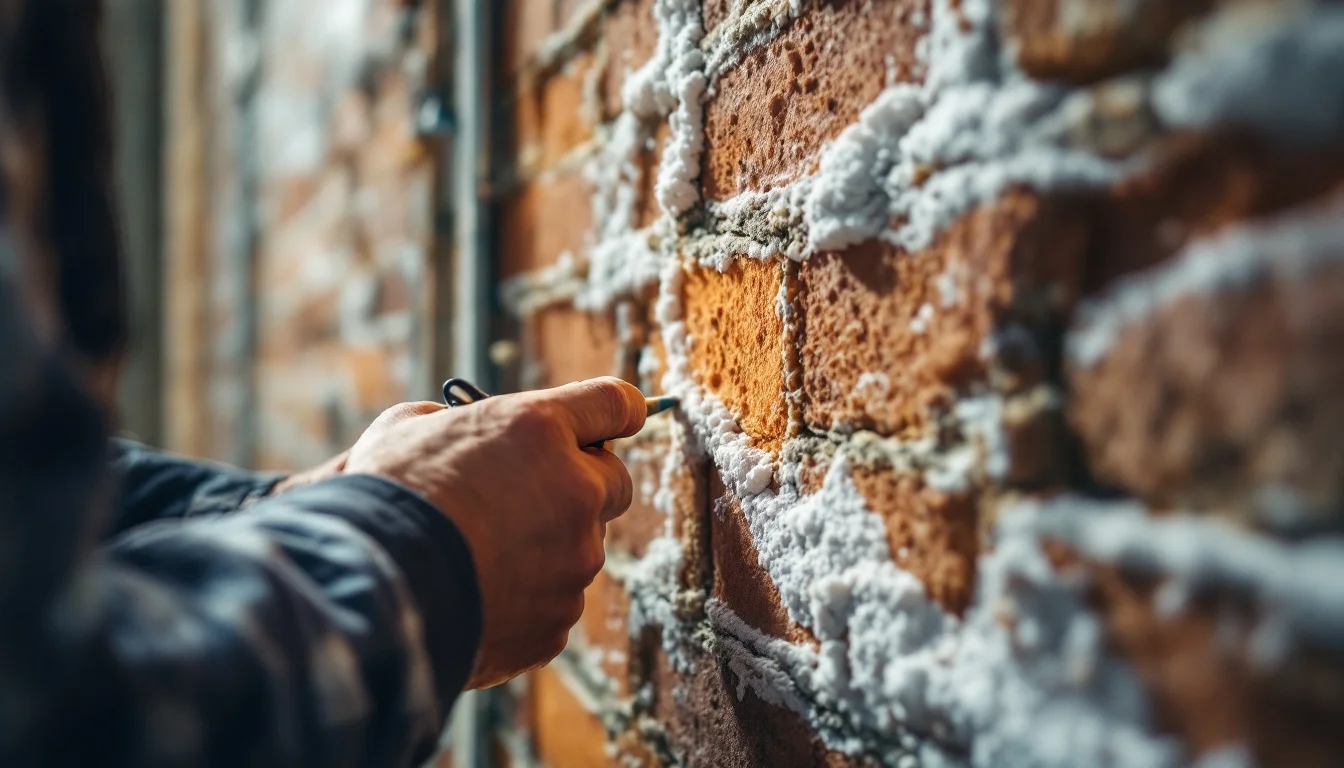
Strip away the marketing and the process is mechanical, almost plumbing-like in its simplicity. An installer drills a pattern of holes, roughly 22mm wide, spaced about a metre apart across the outer wall. Through each hole, they blow insulation — typically polystyrene beads — into the cavity between the two masonry layers. Once a section is filled, the holes are sealed shut with cement and left to blend into the brickwork.
For a standard house with walls that are easy to reach, the whole thing takes about two hours, according to the Energy Saving Trust. There's no scaffolding ritual, no weeks of disruption, no rooms closed off. A crew arrives, drills, fills, seals, and leaves.
That speed is exactly why it gets marketed as a cheap fix for a cold house. But the Energy Saving Trust is explicit that this is not a DIY job: it requires a registered installer, because judging whether the cavity is actually fillable — and filling it evenly without gaps or voids — takes equipment and experience most homeowners don't have.
What the two-hour job doesn't include is the part that precedes it. Before any drill touches the wall, someone has to establish that the cavity is wide enough, dry enough, and sound enough to take insulation without causing problems. That assessment is the real product you're paying for — the drilling and sealing is just the delivery mechanism.
Registered installers can be found through TrustMark, the government-endorsed quality assurance scheme for home improvement work. Once installed, the work should carry a 25-year guarantee, either through the Cavity Insulation Guarantee Agency (CIGA) or an independent insurance-backed guarantee — the first place to check if damp or other problems surface years later. Installers are also required to work around existing ventilation: underfloor grilles, airbricks, wall vents and trickle vents must stay clear rather than be blocked or sealed during the fill. On semi-detached or terraced homes, where the wall is shared with a neighbouring property, the installer has to fit a cavity barrier so the insulation doesn't spread into next door's wall. Flats bring their own rule: a single unit can't be insulated on its own, since the building owner and all occupants need to agree before a whole block goes ahead.
Is your wall even a candidate?
Not every brick wall has a cavity, and not every cavity should be filled. Before anything else, you need to know which kind of wall you actually have.
Brick pattern and wall thickness are useful clues. Per the Energy Saving Trust, walls between 260mm and 350mm thick with a cavity are generally different from solid walls, and in the UK, homes built before 1920 tend to have solid walls rather than a cavity — a rough era marker rather than a fixed rule, since construction methods and dates vary by region.
Age is only a starting clue, not a guarantee of what you'll find. Homes built in the UK from the 1990s onwards generally already have wall insulation, while older properties may not — and the only way to know for certain is to check, rather than assume. A registered installer can confirm this with a borescope inspection, a local authority's building control department holds records for many properties, and the property's EPC will usually note whether cavity insulation is already in place.
Once you know you have a cavity, the next question is whether it should be filled at all. Drawing together the suitability conditions set out by the Energy Saving Trust and the failure causes documented by BH Nest, the checklist below reflects the moisture and condensation risks common to any brick cavity-wall construction — but the specific numbers (minimum cavity width, exposure classification) come from UK guidance, and should be checked against local building standards before being treated as the rule outside the UK.
Green-light conditions
- Unfilled cavity at least 50mm wide
- Cavity clear of rubble or debris
- Masonry in good condition, with sound brickwork and pointing
- Wall not regularly exposed to driving rain
- No history of flooding at the property
- Cavity narrower than 50mm, or uneven in width
- An exposed site with heavy wind-driven rain
- A location at risk of flooding
- Other site-specific risks identified during the wall assessment, rather than a fixed checklist item
- Visible damaged brickwork or mortar, which BH Nest links directly to moisture seeping into the cavity after insulation is installed
The logic connecting the two lists above is the same logic that runs through nearly every documented failure: insulation doesn't create moisture, it just removes the gap that used to let moisture pass through without touching the inner wall. If the wall was already letting water in, filling the cavity gives that water somewhere to sit instead of somewhere to drain. That's why exterior repairs — brickwork, pointing, roofs, overhangs, gutters, downpipes — need to happen before insulation goes in, not after: insulating over an unresolved water problem doesn't just fail to help it, it can trap the damp against the inner wall.
The same logic applies inside the house. Any damp patches already visible on internal walls should be resolved before insulation goes in too, for the same reason: insulation locks in whatever moisture problem already exists rather than solving it.
What the published costs actually tell you
Cost figures for cavity wall insulation travel fast online, usually stripped of the context that makes them meaningful. The Energy Saving Trust cites a typical installed cost of around £2,200 in Great Britain, and around £1,000 in Northern Ireland — UK-specific figures, used here to show how a payback claim is actually built.
The same source states that payback is likely within five years or less, through savings on annual energy bills. That claim is checkable, and checking it is a useful habit for any quote you receive, regardless of country.
Here's the arithmetic behind it, using the GB figure as an illustration. If a £2,200 installation pays for itself in five years or less, the implied annual saving works backward to roughly £440 a year. That's not a measured outcome from any single home — it's the number a five-year payback claim has to imply, given that cost. Whether a real home hits that figure depends on how much heat it was losing through the walls in the first place, which is where the 33% heat-loss figure becomes relevant: a home closer to that average has more to recover than one that's already well sealed.
The exercise matters more than the specific pounds-and-pence outcome. Ask any installer quoting you a payback period to show the saving figure their number implies, the same way the £2,200 example implies roughly £440 a year. If they can't produce that figure, the payback claim is marketing, not arithmetic.
BH Nest's resource adds the practical cost drivers behind any quote: house size, the insulation material used, your location and chosen contractor, and whether any grant support applies. Getting more than one quote remains the simplest way to see how much those variables actually move the price in your area. On the grant side, the UK government's Warm Homes Plan earmarks close to £15 billion for improving homes and cutting energy bills, including fully funded insulation support for people on low incomes and low- or zero-interest loans for other homeowners — worth checking against any grant a contractor mentions.