Lime Render vs Cement Render: The Repair Protocol Every Old-House Owner Needs to Know

Why Cement Render Over Existing Lime Render Can Be a Ticking Time Bomb
Old walls breathe. That's not folklore — it's physics, and it's why covering the solid, permeable walls of an old stone or brick house with modern cement render so often ends badly. Guidance from the Society for the Protection of Ancient Buildings (SPAB) is blunt about it: a modern cement render is "incompatible with the construction of most old buildings" and can cause or accelerate serious decay. SPAB goes further, describing the mid-20th-century habit of covering older lime renders with cement as "a serious time bomb" — damage that can take decades to surface.
The underlying mechanism is well documented, and it applies to any solid-walled old house, wherever it stands.
Key Takeaways
- Breathability, not appearance, is the real issue: old walls need to let absorbed moisture evaporate out; cement render seals it in instead.
- Diagnose before you touch anything. Know whether you're dealing with lime or cement render, and how it's actually failing.
- Don't strip everything off by default. A small trial removal tells you what's going on underneath before you commit.
- Once render comes off, it generally needs replacing — with a lime render, not another cement one.
- Finish with limewash rather than modern paint, to keep the wall breathing.
- Expect a touch-up. Salts trapped behind cement for decades can resurface through new lime render over the following year or two.
Why Does Cement Render Damage an Old Wall?
Old and modern buildings manage water in opposite ways. A solid-walled old house relies on breathability: moisture gets in through driving rain or rising damp, and it needs to evaporate back out again through the wall surface. A modern house instead relies on a ventilated cavity to break the path of water into the building, rather than depending on the wall drying out the way an old solid wall does. Put a modern, impervious system on an old wall and you've removed its only way of drying out.
For timber-framed and earth-constructed buildings, SPAB notes this can mean major structural damage, not just cosmetic staining, once moisture builds up behind the render and has nowhere to go.
The mechanical failure follows a predictable pattern. Portland cement render is largely impervious, so it restricts evaporation from the wall beneath. Because the cement mortar is more rigid than the masonry or timber behind it, hairline cracks open up as the two materials move differently. Those cracks then let water in, but the render's impermeability stops it getting back out — so it stays trapped against the wall.
Lime behaves differently. Lime plasters are porous, so water vapour can pass through them, and the fine cracks that do form in lime render can often self-heal as lime slowly carbonates over time. Sika's heritage render guidance describes lime render as softer and more flexible than cement, moving with the building rather than against it, and allowing moisture to evaporate naturally instead of trapping it.
Is Your Existing Render Lime or Cement? Three Diagnostic Clues
Before deciding anything, you need to know what's actually on the wall. There's no guaranteed DIY test in the available guidance, so treat these as pointers, not proof — a trial area assessed by someone experienced with old buildings is the only reliable confirmation.
- Age of the building. If a building pre-dates roughly 1800, its original render was likely ordinary, non-hydraulic lime, or a natural hydraulic lime with a weak chemical set. Cement render on a building that old is almost always a later addition.
- Appearance. Cement renders tend to look more uniform, with sharper, more clearly defined corners and detailing. Lime render usually looks softer and less machine-precise.
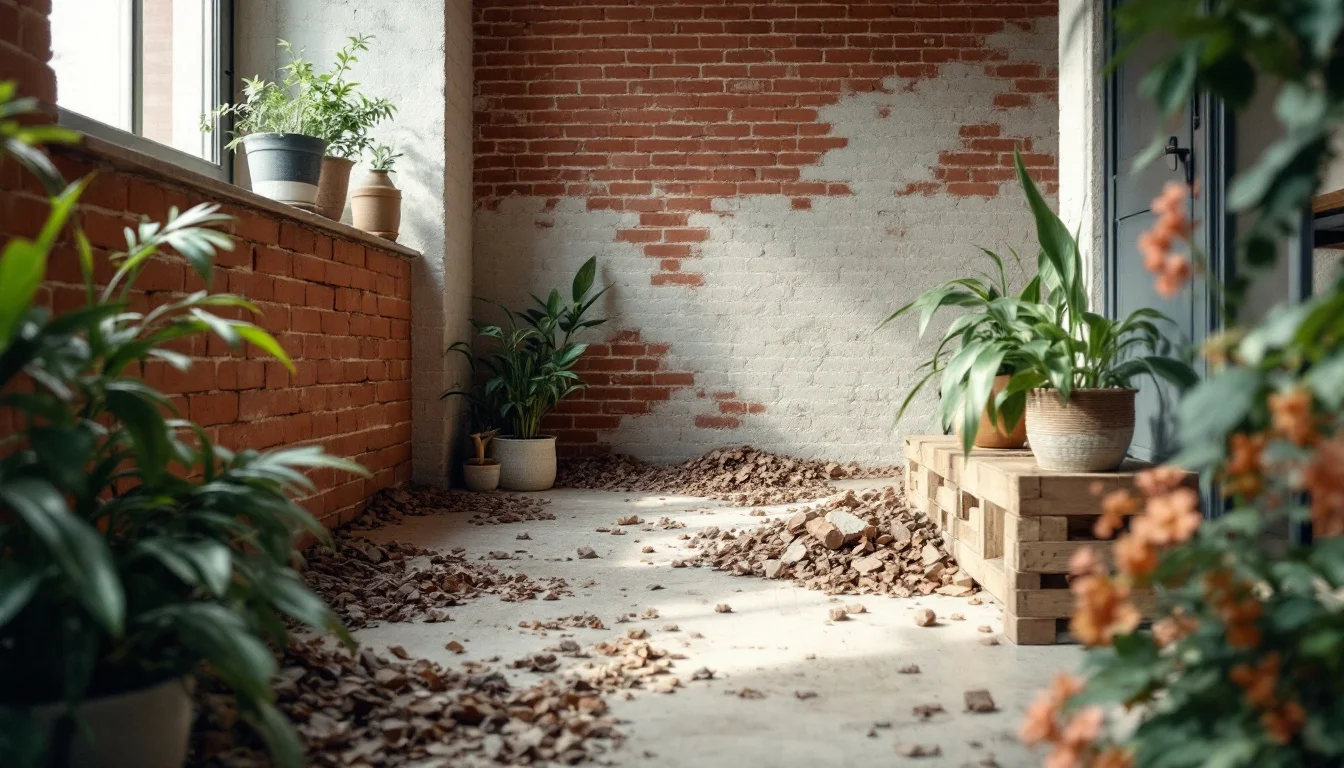
- How it fails. Cement render tends to fail in patches, detaching from the wall in sheets or chunks. Lime render erodes back gradually and evenly over years, rather than falling off in pieces.
Do You Need to Remove All the Cement Render?
This is the question that trips people up most, because the instinct is to assume all the "wrong" render has to come off. SPAB's guidance doesn't support that as a default. Removing all inappropriate cement render isn't necessarily required — and the removal process itself can damage the fabric underneath. A small trial area should come off first, before any wider decision gets made.
From that starting point, the guidance points to three broad situations:
- Well-adhered render. Where cement render is sound and still firmly stuck to the wall, it's probably best left alone to age naturally. Removing it would risk more damage than leaving it.
- Partially failing render. Where it's hollow-sounding or failing in patches, a compromise is often workable: remove render only at wall bases, or at the specific hollow or detached patches, rather than the whole elevation.
- Widespread failure. Where the trial removal confirms extensive detachment, trapped moisture, or decayed backing across the wall, fuller removal is usually the only realistic option.
How Cement Render Is Safely Removed
Removal is specialist work, not a weekend DIY job, particularly on soft or historic masonry. SPAB's guidance describes working over the surface methodically with a hammer and chisel, taking it off in small sections rather than in one go.
Levering off large sheets of render is specifically flagged as risky: it can seriously damage soft brick, stone or earth construction underneath, pulling away material that was never meant to come off with it.
Power tools can speed the job up, but the guidance is clear that they belong only in highly experienced hands. On an old wall, the margin between removing render and gouging the substrate underneath it is thin. If you're hiring help for this stage, their experience with old buildings matters more than their speed.
What Happens After the Cement Render Comes Off? A Realistic Timeline
The sequence usually runs like this, though timing depends on how wet the wall is.
- Trial removal confirms the extent of the problem, as covered above.
- Full removal follows, if the trial shows it's warranted, using the hammer-and-chisel method on sound masonry.
- Drying out. If the wall fabric is saturated — which is common after decades under cement — re-rendering needs to wait. Applying new render over a wet wall traps the problem instead of solving it.
- Repair of decayed backing. Any masonry, timber or earth substrate that's deteriorated behind the old render needs to be made sound before anything new goes on.
- Lime re-render. Whether to leave the wall bare or re-render it should depend on evidence of the original finish and on how exposed the wall is, not on a blanket assumption — many old buildings were rendered from the outset, but others were built to be left as exposed stone or brick.
- Monitoring for salts. A wall that's worn cement render for decades has likely accumulated salts. New lime render can act almost like a poultice, drawing those salts out, which can cause localised decay in patches.
- Remedial touch-up. Because of that salt migration, a round of remedial re-rendering a couple of years later is a realistic possibility, not a sign the first job failed.
What Should Cement Render Be Replaced With? Resolving the Lime Debate
The baseline guidance from SPAB is clear: inappropriate cement render should generally be replaced with a weaker, more permeable lime render, without added cement, applied by someone familiar with lime materials. That's the default starting point for most old solid-walled houses.
Where a faster or harder set is genuinely needed, SPAB allows for pozzolans or a natural hydraulic lime used without additives, while cautioning against strong hydraulic limes and epoxy resins, which behave too much like cement.
Commercial heritage render ranges complicate this slightly. Sika markets hydraulic lime-based systems specifically for renovating old and traditional buildings, describing them as lightweight, weatherproof and breathable. That's not necessarily a contradiction of SPAB's position — it's a reminder that "hydraulic lime" covers a range of strengths, from mild to strong, and the right one depends on the substrate and how exposed the wall is. The two sources aren't simply agreeing with each other; they're describing different points on the same spectrum. The practical takeaway is to treat strength as a variable to get right, not a product to pick off a shelf — a lime specialist who can assess your specific wall is worth more than a label.
Finishing and Maintaining a Lime Render
The finish coat matters as much as the render underneath it. A traditional limewash is normally the most appropriate coating for new lime render, because it shares the same breathability. Standard modern paint systems have lower permeability and risk trapping moisture against the wall — exactly the problem the whole protocol is designed to avoid. Colourless water-repellent coatings are inadvisable for the same reason.
Once the render and limewash are on, upkeep is straightforward but worth sticking to:
- Inspect yearly, especially after a stretch of bad weather.
- Clean with a soft brush or clean water only; avoid high-pressure washing, which can strip or damage the surface.
- Repair any damage with matching lime-based products, never a cement-based filler or patch.
FAQ: Lime Render for Old Houses
Can lime render go over a previously painted or modern wall? Not without specific preparation. Lime renders adhere best to traditional substrates such as rubble stone, brick, soft stone, rammed earth, cob or hemp. They're generally not suitable for modern impermeable or cement-based surfaces without extra work to improve the bond.
How long before I can paint new lime render? Lime render needs time to carbonate before breathable mineral paints or limewash tints are applied. A figure of around 28 days is often cited as a minimum, but full carbonation can continue for weeks to months beyond that, depending on the render's thickness, the weather conditions, and the type of lime used. Rushing this step undermines the finish.
Is lime render as durable as cement render? Correctly applied, lime render can last for decades. Its durability comes from working with the building's moisture movement rather than against it, which is also why poorly matched cement repairs tend to fail faster on old walls.
Is working with lime render dangerous? In powdered form, lime is highly alkaline and requires gloves, eye protection and a mask when mixing and applying it. Once it's cured on the wall, it's completely safe and non-toxic.
Conclusion: Reversibility Is the Real Long-Term Value
The most consequential difference between lime and cement render rarely comes up in the sales pitch. Lime renders are generally easier to remove or repair in future without damaging the substrate, because lime is deliberately softer and more flexible than the masonry or timber it protects — it moves with the building rather than against it. Cement render doesn't offer that option — it's effectively a one-way decision, bonded onto a wall it was never designed to work with. Choosing lime today doesn't just solve a moisture problem. It keeps the wall's options open for whoever repairs it next.