Types of Concrete Explained: Matching Mix, Load and Pour to the Job
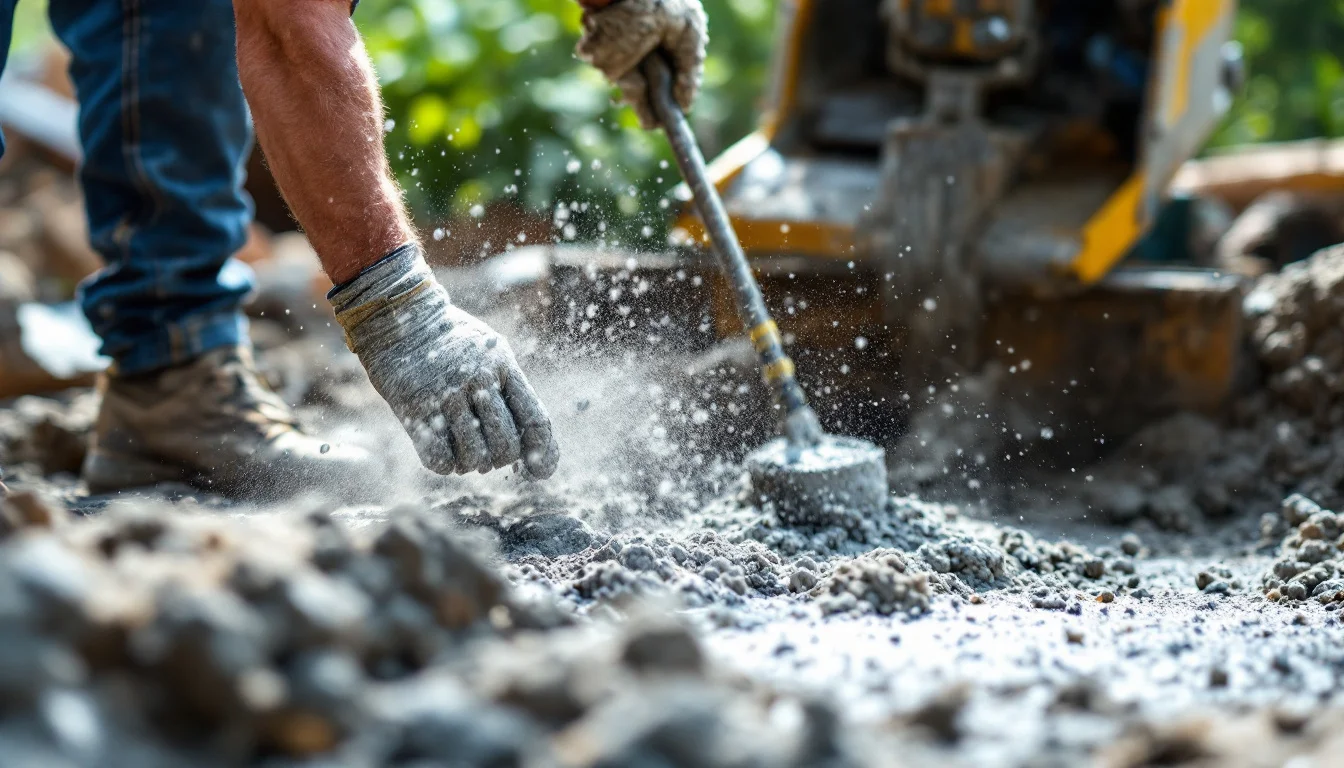
Concrete does not rust, rot or burn, which is exactly why it ends up everywhere from garden paths to motorway bridges. But "concrete" is not one product. It is a family, and most members of that family are built from the same three raw ingredients: fine aggregate, coarse aggregate and Portland cement, mixed with water.
Fine aggregate fills volume. Coarse aggregate is what actually carries the load. Get the balance wrong for the job in front of you, and the mistake does not show up as a slightly higher material bill. It shows up as a cracked slab, a porous driveway, or a pour that has to be broken out and done again. That is the real cost of picking the wrong type.
Key Takeaways
- Admixtures are chemicals added to a mix to change how it handles and how strong it ends up — they are the difference between a mix that suits your site and one that fights you on the day.
- More cement paste makes a mix easier to place and smoother to finish, but it costs more and cracks more easily — paste quantity is a trade-off, not a free upgrade.
- Ready-mixed concrete comes in three delivery styles — transit-mixed, shrink-mixed and central-mixed — and the right one depends on distance from plant to site, not personal preference.
- Lightweight concrete is defined by a density threshold, achieved with aggregates like pumice, clay or perlite, used specifically to cut a structure's dead weight — at the cost of some compressive strength.
What's Really in the Mix: Why Water-Cement Ratio Decides Everything
Most types of concrete described further down this page are a variation on one chemical fact: Portland cement is a hydraulic cement. It does not dry out to gain strength — it reacts chemically with water. That reaction is what turns a loose pile of aggregate into a rock-like mass, and cement is the glue that binds the coarse and fine aggregate together while that reaction runs its course.
The lever that controls almost everything about how a mix behaves is the water-to-cement ratio, because the quality of the cement paste depends on it.
Too little paste, too much paste
Get the paste wrong in either direction and the problems are different but both real:
- Too little paste to fill the gaps between aggregate particles makes the mix hard to place, and leaves you with a rough, porous surface once it cures.
- Too much paste is the opposite problem. It places easily and finishes smooth, but it is not cost-effective, and a paste-heavy mix cracks more readily as it cures.
The Default: Normal-Strength and Plain Concrete
Most of what gets poured on an ordinary renovation or small build is normal-strength concrete: a basic mix of cement, aggregate and water, with no special additives. It is the workhorse for pavements, slabs and home construction projects that are not being asked to carry unusual tensile loads.
Plain concrete is the same idea described from the structural side — concrete in its simplest form, with no reinforcement at all. It is entirely adequate for walkways, pavements and similar structures that never need to resist serious bending or pulling forces.
The line to notice here is the one between plain and reinforced. Plain concrete handles compression — being pushed together — very well. It is poor at handling tension, being pulled apart. That single limitation is the reason reinforced concrete exists as a separate category, covered further on, once the logistics of getting concrete to site have been dealt with.
Ready-Mix: The Logistics Decision Behind the Material Decision
Ready-mixed concrete is not really a different material. It is a different way of getting the material to you. It is batched at a plant and delivered by mixer truck, usually with admixtures added so the cement does not start hardening before it reaches your site and is still workable when it arrives.
Each batch is made to the contractor's specification rather than mixed on site, and it is delivered still in a plastic, workable state. That one feature — batching off-site instead of on-site — is why ready-mix shows up everywhere from sidewalks and skyscrapers to bridges, motorways and dams. It is especially suited to large jobs where there simply is not room on site for a mixing plant and aggregate stockpiles.
Three delivery methods, three different trade-offs
Ready-mixed concrete is not a single logistics method either. There are three principal categories:
- Transit-mixed: materials are batched at the plant, then fully mixed inside the truck and kept agitating during transit. Adjustments can still be made at the jobsite, within the limits the project specification allows — useful if conditions on arrival are not quite what was planned for.
- Shrink-mixed: mixing starts in a stationary mixer at the plant and is finished off in the truck mixer on the way — a middle ground between the other two.
- Central-mixed: the concrete is fully mixed in a stationary mixer at the plant before it ever leaves, then delivered by truck mixer, agitating truck, or non-agitating truck. The non-agitating option only works over shorter transport distances, because nothing is keeping the mix moving en route.
Reinforced Concrete: When Compressive Strength Alone Isn't Enough
Reinforced concrete solves the weakness plain concrete has. Steel reinforcing bars (rebar) are embedded in the mix to add tensile strength that concrete alone does not have. Concrete is good under compression; steel is good under tension. Combine them, and the resulting structure can handle loads that would crack plain concrete apart.
That combination is why reinforced concrete is the default for large-scale structures that need to resist real tensile forces: tall buildings, bridges, dams, and anything else carrying extremely heavy or uneven loads. If a structural engineer is involved in a project at all, reinforced concrete is usually already assumed rather than discussed.
Lightweight Concrete: Trading Density for Load Management
Not every concrete problem is about strength. Sometimes it is about weight. Lightweight concrete swaps the usual coarse aggregate for materials like pumice, clay or perlite, bringing the density below 1920 kg/m³.
That lighter aggregate does cost something: lightweight concrete typically gives up some compressive strength compared with a normal-strength mix. The trade-off is deliberate, because the reduced density is the point — it matters in walls or flooring where cutting a building's dead weight is part of what keeps it from collapsing under its own mass. On upper floors, additions, or anywhere the existing structure below cannot take extra dead load, lightweight concrete shifts the calculation from "is this strong enough" to "is this light enough, without giving up more strength than the job can afford."
Pervious Concrete: Designed to Fail at Holding Water (On Purpose)
Pervious concrete flips the usual goal of a dense, watertight pour. It is deliberately more porous, so water passes through it down to the groundwater below, instead of sitting on the surface or running off somewhere else. It is used for roads and pavements specifically to manage stormwater buildup rather than to carry structural load.
The porosity is not a minor effect. Pervious concrete can absorb water at a rate of roughly 3 to 8 gallons per minute per square foot of surface. On a driveway or a car park, that is the difference between standing water after rain and a surface that simply drains itself.
Specialty Mixes: Polymer and Glass Concrete
Two further types solve problems that have nothing to do with structural load.
Polymer concrete
Polymer concrete replaces Portland cement with a polymer binder — polyester, epoxy, vinyl ester or acrylic are all used. The binder choice changes the behaviour: epoxy binders reduce shrinkage as the material cures, while acrylic binders offer better weather resistance and set faster. Across binder types, polymer concrete delivers higher tensile strength and better corrosion resistance than ordinary mixes. That combination is why it turns up in swimming pools, sewer structures, and anywhere else concrete sits in constant contact with liquids and corrosion-causing chemicals.
Glass concrete
Glass concrete uses recycled glass as an aggregate, replacing some or all of the fine or coarse aggregate in the mix. The visual result is a shiny, sparkling finish, which is why it is chosen for countertops, floors and tiles rather than structural work. It is the surest route to a decorative, polished-looking finish — a genuinely different category from the structural types above, chosen for appearance rather than load.
Which Type Do You Actually Need? A Quick-Reference Comparison
| Type | Typical use | What makes it behave differently | Main trade-off to flag |
|---|---|---|---|
| Normal / plain | Pavements, walkways, basic home construction | Basic mix, no reinforcement | Poor tensile strength — not for high-load or bending forces |
| Ready-mix | Any job, especially space-constrained sites | Batched off-site, delivered plastic and ready to pour | Delivery method (transit, shrink, central-mixed) must match site distance |
| Reinforced | Tall buildings, bridges, dams, heavy loads | Rebar adds tensile strength concrete alone lacks | Needs design and placement planning before the pour |
| Lightweight | Upper-floor walls, flooring over weak structures | Density below 1920 kg/m³ via pumice, clay or perlite | Trades some strength for reduced dead weight |
| Pervious | Roads, driveways, stormwater management | Porous structure lets water pass through to ground | Not meant for heavy structural load |
| Polymer | Pools, sewer structures, chemical exposure | Polymer binder instead of cement | Higher material cost for corrosion resistance |
| Glass | Countertops, floors, decorative tiles | Recycled glass aggregate gives shine or glow | Decorative purpose, not a structural choice |
FAQ
What happens if a ready-mix delivery is delayed before pouring? Remember that Portland cement hardens through a chemical reaction with water, not by drying out. Ready-mix trucks carry admixtures precisely to slow that reaction down so the load stays workable in transit. A short delay is usually absorbed by that buffer, and transit-mixed loads keep agitating the whole way, which helps. But once the admixture's working window runs out, the chemical reaction keeps going regardless of whether the truck has arrived. A long delay is not a scheduling inconvenience — it is the hydration clock running out before the concrete ever reaches the formwork.
Can plain concrete be reinforced after it's already poured? Not in the way it's done before a pour. Embedding rebar through the wet mix before it cures, so the steel and concrete bond and cure together, is the standard way to build in tensile strength, and that specific process can't be redone once the concrete has set. But existing concrete isn't necessarily stuck as-is: approaches such as bonding steel plates or fibre-reinforced polymer wraps to the surface, installing post-installed anchors, or adding a bonded concrete overlay can add tensile capacity without demolishing the structure. Breaking it out and starting over is one option, not the only one, and is usually a last resort rather than the default fix.
Is lightweight concrete too weak for a structural wall? Lightweight concrete does trade away some compressive strength compared with a normal-strength mix, but that is an accepted cost rather than a disqualifying flaw — it is used in walls and flooring specifically because cutting the building's own weight is the point, not because the material fails at bearing load. Whether a given lightweight mix suits a particular wall depends on what that wall needs to carry, which is a site-specific question rather than a blanket limitation of the material.
Conclusion
The seven types covered here are not a catalogue to memorise. They are an answer to three questions a batching plant will ask before sending a truck: what load does this need to carry, what is the site actually like to pour on, and how much time do you have before that chemical reaction locks the mix in place. Answer those three honestly, and the right type becomes obvious. Skip them, and the cheapest mix on the price list can turn out to be the most expensive decision on the job.