Flat Roof Drainage: How to Get It Right and Avoid Pooling
Why Flat Roofs Fail Where Pitched Roofs Don't
A puddle still sitting on a roof two days after the rain has stopped is not a cosmetic detail. It is often the first visible sign that a flat roof's drainage was never designed to cope with the weather it now has to handle.
In building terms, a flat roof is any rooftop that is almost level, with a pitch under 10 degrees, according to manufacturer Pipelife's 2024 overview of flat-roof drainage (Pipelife, 2024). That near-flatness is the root of the problem: unlike a pitched roof, a flat one does not shed water on its own, so every drop has to be guided off through drains that are sized, placed and maintained correctly.
Across Europe, heavy downpours are now showing up in places where they used to be rare, part of a broader shift toward warmer, wetter conditions described in the same Pipelife overview. Much of the drainage installed decades ago was never built for this. The fix is rarely a better drain. It is a design that assumes the main drain will, at some point, clog or fall short.
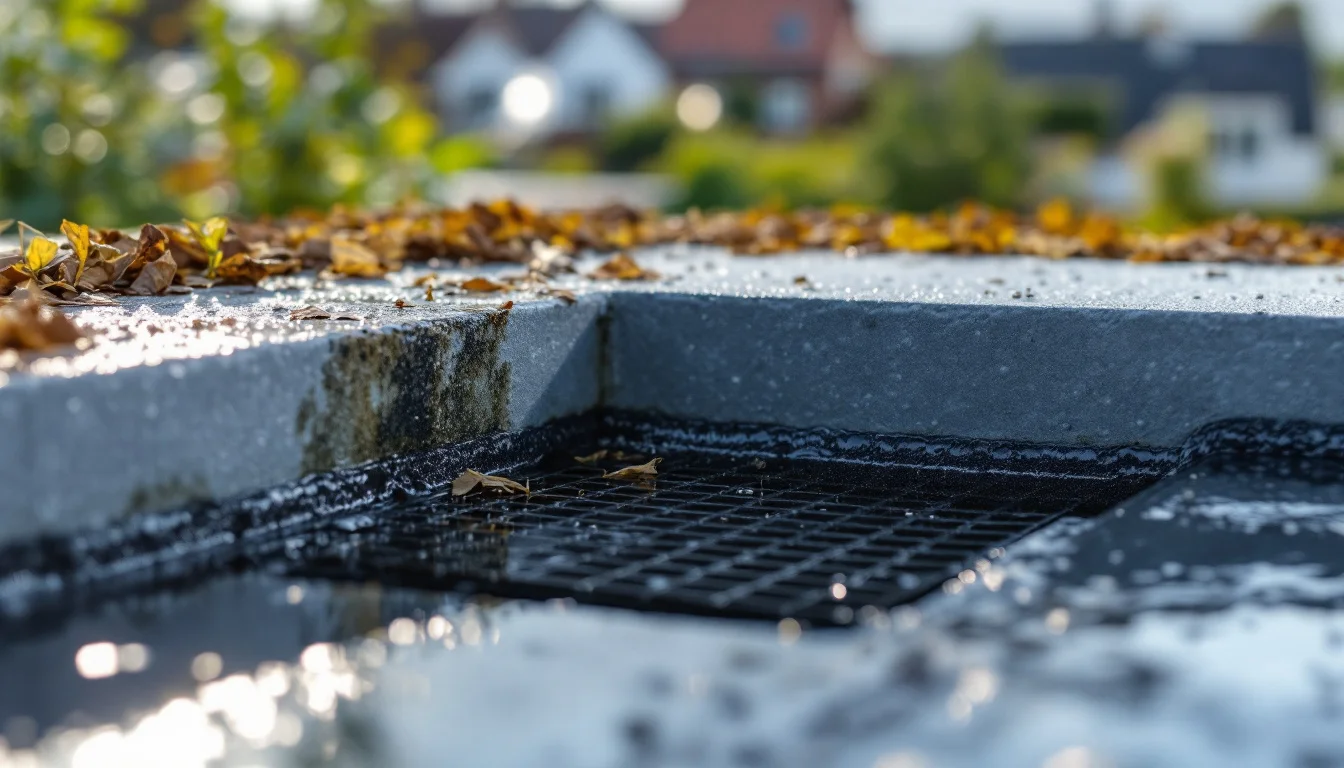
That vulnerability is built into the roof type itself, not just its age. Because flat rooftops cannot rely on slope to clear water, they are susceptible to accumulation, leaks and structural damage whenever the drainage falls short, according to the Pipelife overview. The same source notes that even a brief period of rain can lead to standing water on a flat roof without an adequate drain system — not just the kind of sustained, days-long downpour that stress-tests every roof in a region, but an ordinary shower that a sloped roof would clear without anyone noticing. Left in place, that water compromises the roof's structural integrity over time and shortens its lifespan, which is why a quality drainage system is described as a necessity for flat roofs rather than an upgrade. The practical implication is that flat-roof drainage cannot be treated as a smaller version of a gutter system on a house. It has to be engineered for a surface that offers water nowhere to go except through the outlets built into it.
Key Takeaways
- Even a short, ordinary rain shower can leave standing water on a flat roof if the drainage isn't adequate for it.
- Drainage needs to be hydraulically balanced: sized for everyday rain, but able to cope with a rarer downpour too.
- The single most cost-effective design choice is a primary drain system for normal rainfall, backed by a secondary overflow route for when the main drains clog or are overwhelmed.
- Pooling problems generally come down to a design flaw, a maintenance gap or an installation error — rarely the drain product itself.
- No confirmed Belgian figures exist for overflow clearances or drain placement; the 2-inch US figure referenced in this article comes from a secondary US roofing-industry source, not verified against the official code text, and should not be assumed to apply locally.
Does Your Flat Roof Need a Secondary Overflow?
Ask a roofer what separates a flat roof that shrugs off a storm from one that floods the ceiling below, and the answer is rarely the drain brand. It is whether the roof has a second way out for the water.
The logic of redundancy
A well-designed drainage system is hydraulically balanced: sized for the rain that falls most days, but able to cope with the occasional deluge, according to Pipelife's 2024 drainage overview. The most cost-effective way to achieve that, per the same source, is a primary drainage system built for everyday rainfall intensities, paired with a secondary — or overflow — system that gives water an alternative route off the roof if the main drains block or are overwhelmed.
The National Roofing Contractors Association (NRCA) recommends multiple, properly spaced drains per drainage area, so that a second drain keeps water moving if the first one clogs. US roofing-industry guidance also describes the US model plumbing code — the International Plumbing Code (IPC) — as requiring a secondary overflow path on every drainage area, positioned at least 2 inches — roughly 5 cm — above the primary drain; this article has not independently verified that figure, or the specific code section it is attributed to, against the official IPC text. Belgium has no equivalent figure confirmed in available sources. The exact overflow clearance to use on a Belgian roof should be confirmed with an architect or the local building-permit authority before a design is finalized, not assumed from a foreign code.
Why the 48-hour mark matters
The NRCA also defines ponding water as standing water still present 48 hours after rain stops — a threshold it links to accelerated wear on roofing membranes. A puddle that clears within a day is ordinary on a flat roof. One still sitting there two days later points to a drainage design problem, not just unlucky weather.
Matching the drain type to the roof size
Not every flat roof needs the same hardware, and the right choice depends heavily on scale.
For small-to-medium roofs, scupper drains — simple openings placed along the roof's edge or in parapet walls, also known as external drains — provide a simple and cost-effective way to direct water off the building, and they are often combined with conventional gutters and downspouts to carry that water further away from the structure.
Average-sized flat roofs more often use gravity systems built around central, or internal, drains. These require a greater number of drainage points spread across the entire rooftop to keep water moving efficiently, but the payoff is a cleaner building exterior: because the drainage runs through the interior plumbing system rather than down external pipework, the facade stays uncluttered.
For large-scale residential, industrial and commercial buildings, siphonic — or vacuum — drainage systems are generally regarded as the most effective solution, because they need far fewer pipes and outlets than a gravity system of the same capacity, and their internal drains can be laid without any slope at all, which frees up interior space that would otherwise be given over to plumbing runs.
Manufacturer figures give a sense of what that technology can do at the top end. Pipelife's own siphonic system is designed for flat roofs with up to a 3% incline and a minimum area of 150 m², and it is built to work with cold, insulated, inverted and green roof constructions alike. Its DN75 outlets have been tested to a flow rate of up to 20 litres per second — which the manufacturer says is 60% higher than standard siphonic systems — and the company states the system has a service life of at least 50 years, matching a building's expected lifetime, though that figure comes from the manufacturer rather than independent testing. Pipelife also reports that preassembling the siphonic components speeds up installation by at least 15–20% compared with standard, non-preassembled siphonic systems. None of these numbers substitute for a project-specific hydraulic calculation, but they illustrate the order-of-magnitude difference siphonic systems can make on a large roof.
What actually causes pooling
When standing water does show up, it is worth tracing which of three stages went wrong, because the fix is different in each case.
Design errors sit at one end. Suboptimal placement of outlets, or a primary drain sized too small for the area it serves, can let air enter the drain itself — and that slower, air-disrupted flow is enough on its own to cause water to accumulate on the roof surface, even before any blockage occurs.
Maintenance gaps sit in the middle, and they are arguably the most common culprit of all. Debris buildup — silt, leaves, dirt and other material washed or blown onto the roof — is described as one of the most frequent causes of improper drainage and standing water on flat roofs, regardless of whether the underlying design was sound. A well-engineered drain that nobody clears will fail in exactly the same way as a badly designed one.
Installation errors carry the highest stakes of the three. A system that has not been installed correctly can cause water pooling, leaks and mould growth, and in the more serious cases contributes to structural damage or even roof collapse. That is the practical argument for insisting that installation be carried out by certified roofing professionals working to local building codes, rather than treating it as routine plumbing work that any contractor can handle.
The roofing material itself plays a smaller, but still measurable, role. The slope and texture of the material influence how efficiently water reaches the drain openings in the first place: a slight slope helps guide water toward the drainage area, while a smoother surface finish cuts down the friction that would otherwise slow its path. On a roof that is pooling despite having drains that look adequate on paper, the membrane's own slope and surface condition are worth checking alongside the drains themselves.